

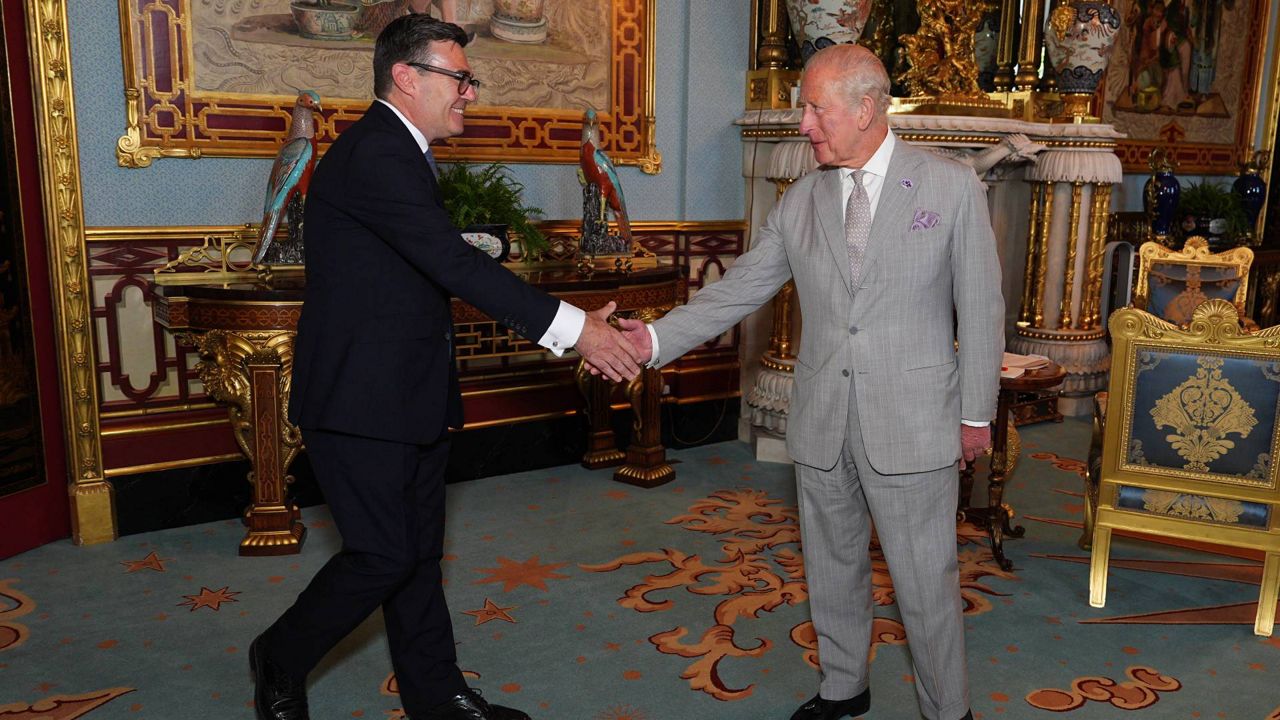
The outgoing Prime Minister, Keir Starmer, had tendered his resignation to the King shortly before Burnham’s arrival. Starmer’s audience was briefer, lasting around ten minutes, and was followed by a short statement in which he expressed gratitude to the King for his service and wished his successor well. The courtesy of the exchange, conducted without rancour or public recrimination, was noted approvingly by constitutional scholars as evidence of the health of Britain’s unwritten constitutional settlement.
Advertisement
The day’s events unfolded against a backdrop of intense media attention. Broadcasters had established live positions outside the Palace from dawn, and the arrival and departure of the two prime ministers’ cars were tracked by satellite feeds and social media in real time. Yet the actual transfer of power, when it came, was almost invisible — a quiet conversation in a gilded room, a handshake, a car journey back down the Mall. The contrast between the media frenzy and the constitutional calm was, in its way, a perfect encapsulation of the British system: dramatic in appearance, mundane in execution.
Constitutional experts were unanimous in their assessment that the process had been handled impeccably. The professor of public law at University College London noted that the speed and smoothness of the transition reflected “the extraordinary strength of conventions that have evolved over three centuries.” “There is no written constitution that mandates any of this,” the professor observed. “It works because everyone involved understands their role and respects the boundaries of that role. The King does not choose the prime minister. He invites the person who commands the confidence of the House of Commons. That distinction is everything.”
The public reaction was characteristically understated. Social media trends briefly, as they always do on such occasions, with a mixture of genuine interest, mild curiosity and the inevitable memes. The hashtag relating to the Palace audience trended for several hours, though it was swiftly displaced by the evening’s football coverage. In the pubs and cafes of the country, the change of government was discussed with the pragmatic, slightly weary engagement that the British public reserves for political events that affect their lives but do not, in the immediate moment, alter them dramatically.
For Burnham, the Palace audience was the culmination of a political journey that had begun in the early 1990s, when a young trade union researcher from Leigh first stood for Parliament. It was also, in a more immediate sense, the beginning of the hardest job in British public life. The car that carried him back to Downing Street was the same black Jaguar that had carried his predecessors through wars, recessions, scandals and triumphs. The door that closed behind him was the same door that had closed behind Churchill, Attlee, Thatcher, Blair and Cameron.
The continuity was the point. In a country that has dispensed with revolution, that has evolved rather than overthrown, that prefers incremental change to dramatic rupture, the quiet handshake in the 1844 Room was not an anticlimax. It was the system working exactly as it was designed to. And in that, perhaps, lay its deepest reassurance.