

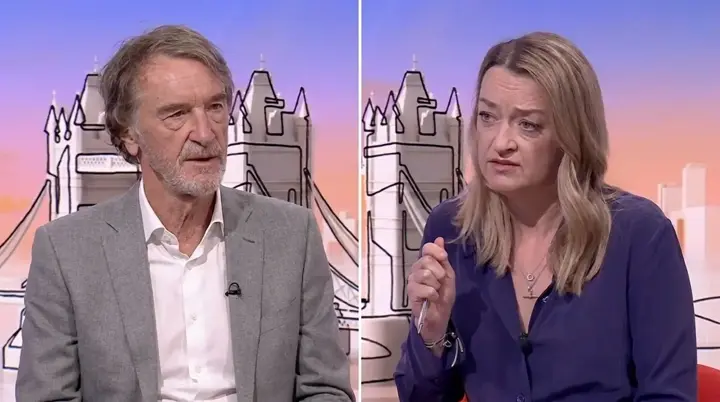
Sir Jim Ratcliffe has spent much of his career building businesses away from the daily attention of the British public.
Advertisement
Manchester United changed that.
Since the billionaire founder of INEOS acquired a major minority stake in one of the world’s most famous football clubs and assumed responsibility for its football operations, decisions carrying his name have been examined in extraordinary detail.
Managers. Players. Jobs. Spending. Old Trafford. Ticket prices. The future of the club itself.
And behind many of those individual controversies sits a question familiar to journalists such as Laura Kuenssberg:
What happens when enormous power is concentrated in the hands of a small number of people — and their decisions begin affecting institutions millions consider their own?
For Ratcliffe, that question has become increasingly difficult to escape.
Ratcliffe Did Not Buy an Ordinary Business
Manchester United may technically be a company, but supporters have never treated it like one.
It is an institution built over generations.
When Ratcliffe’s investment was completed in February 2024, he spoke openly about restoring a club that had failed to win the Premier League since Sir Alex Ferguson’s departure in 2013.
He acknowledged that something was wrong with the environment at United and urged patience, saying the club needed to move carefully towards the right solutions rather than rush towards the wrong ones.
The ambition was enormous.
So were expectations.
For supporters frustrated by years of underperformance under the Glazer family’s ownership, Ratcliffe initially represented the possibility of fundamental change.
But changing Manchester United has proved considerably more complicated than buying into it.
The Decisions Quickly Became Painful
Ratcliffe’s arrival was followed by an aggressive attempt to reduce costs and restructure the organisation.
Jobs were cut.
Long-established practices were reconsidered.
Departments were reorganised.
The argument from the new leadership was essentially that Manchester United had become inefficient and needed to operate very differently if it wanted to compete again at the highest level.
For a businessman accustomed to restructuring industrial companies, there was a certain logic to the approach.
But football creates a problem that conventional businesses do not.
Every decision has an audience.
And that audience cares deeply.
A spreadsheet may identify an expense.
A supporter may see a tradition.
An executive may see restructuring.
An employee may see the end of a career.
That tension has followed Ratcliffe throughout his attempt to rebuild United.
Even the Future of Old Trafford Became Part of the Debate
Then there is the stadium.
Old Trafford is one of the most recognisable football grounds in the world, but its ageing infrastructure has become symbolic of Manchester United’s broader decline.
Ratcliffe has been willing to think much bigger than simply repairing it.
From the early stages of his involvement, he discussed the possibility of creating a major new stadium capable of serving not merely Manchester United but the wider north of England.
The idea demonstrated the scale of his ambition.
It also raised another question.
How much should private ambition depend upon public support?
Major stadium and regeneration projects inevitably involve transport, infrastructure, planning authorities and potentially government participation.
At that point, a football story starts becoming a political one.
This Is Where Laura Kuenssberg’s World Meets Ratcliffe’s
Laura Kuenssberg has spent years interviewing the people responsible for Britain’s biggest political decisions.
Prime ministers, ministers and opposition leaders are routinely confronted with questions about responsibility, money and power.
Ratcliffe operates in a different arena.
He is not an elected politician.
But Britain’s most powerful business figures increasingly make decisions capable of producing consequences that resemble political ones.
They employ thousands of people.
They control culturally important institutions.
They influence investment.
And their decisions can transform communities.
Manchester United makes that dynamic particularly visible.
The club’s supporters do not vote for Ratcliffe.
Yet decisions made by Ratcliffe and the executives around him can affect an institution that forms part of the identity of Manchester and commands a global following numbering in the hundreds of millions.
That creates a strange form of accountability.
Ratcliffe Has Never Hidden His Philosophy
One thing has remained consistent throughout his involvement with United: Ratcliffe has repeatedly presented himself as someone interested in long-term structural change rather than quick reactions.
That became particularly clear when questions surrounded the future of manager Ruben Amorim.
Ratcliffe publicly argued against running the club through “knee-jerk” decisions and indicated that Amorim needed significant time to demonstrate whether he could succeed.
It was consistent with the message Ratcliffe had delivered when his investment was first completed.
Manchester United’s problems had accumulated over many years.
He did not believe they could be repaired overnight.
But patience becomes harder to sell when results fail to meet expectations.
The Billionaire Problem
There is also a broader reason Ratcliffe attracts attention.
Britain has an increasingly complicated relationship with billionaires.
Successful entrepreneurs can create enormous companies, employment and investment.
At the same time, the influence accumulated through that wealth creates legitimate questions about accountability.
Ratcliffe embodies both sides of that argument.
INEOS grew into an enormous international industrial group.
His business career made him one of Britain’s most prominent entrepreneurs.
That same wealth eventually allowed him to acquire a powerful position inside Manchester United.
For supporters, however, the size of his fortune is largely irrelevant.
They judge him by something much simpler:
Is Manchester United getting better?
That Question Has Become Impossible to Avoid
This is ultimately why the Ratcliffe story extends beyond football.
When a billionaire takes control of something people feel belongs partly to them culturally, conventional ideas about ownership become complicated.
Legally, supporters do not own Manchester United.
Emotionally, many believe they do.
Ratcliffe therefore occupies an unusual position.
He has the authority to make decisions.
Supporters have the ability to judge those decisions publicly.
Journalists have the ability to question them.
And politicians can become involved whenever the consequences extend beyond the boundaries of Old Trafford.
It creates precisely the kind of intersection between money, power and accountability that dominates Britain’s wider public debate.
Laura Kuenssberg Represents the Other Side of That Equation
Kuenssberg’s career has largely been built around questioning people with power.
The individual sitting opposite the interviewer changes.
The underlying principle does not.
Why was this decision made?
Who benefits?
Who pays?
What happens if it fails?
And who ultimately takes responsibility?
Those questions apply just as naturally to Britain’s corporate leaders as they do to its politicians.
Ratcliffe’s transformation of Manchester United provides an unusually visible example.
Every major decision can be measured.
Every promise can eventually be compared with reality.
And millions of supporters are watching.
Ratcliffe’s Legacy at United Is Still Unfinished
It is far too early to know how history will judge Jim Ratcliffe’s involvement with Manchester United.
His original ambition was unmistakable: restore one of football’s greatest institutions to the level it once occupied.
Achieving it requires considerably more than money.
United need sporting stability, intelligent recruitment, better infrastructure and an organisation capable of competing with clubs that spent years modernising while Old Trafford fell behind.
Ratcliffe knew the scale of that challenge when he arrived.
What he could not control was how closely every step would be examined.
That may ultimately become the defining feature of his Manchester United experiment.
A businessman who spent decades building an empire is now trying to rebuild something millions of people believe is more important than any ordinary company.
And in modern Britain, people with that much influence rarely get to make their biggest decisions without somebody asking difficult questions.
That is where the worlds of Jim Ratcliffe and Laura Kuenssberg ultimately meet — not through a fabricated television confrontation, but through the much bigger British argument about power, responsibility and who gets to demand answers.
Для креатива я бы здесь особенно рассматривал “Jim Ratcliffe Is Facing Questions Few Expected When He Took Control”, “The Questions Surrounding Jim Ratcliffe Are Getting Harder to Ignore” или вариант с обоими именами: “Jim Ratcliffe & Laura Kuenssberg: The Question of Power Britain Can No Longer Ignore.”